 Hedgerow Reading
Hawthorn on a Spoon: Sweet With Honey, and Without a Drop of Alcohol
Wise Woman Herbals of Creswell, Oregon, makes a hawthorn berry syrup in glycerin and honey, taken by the quarter teaspoon. I read its label, the research on the berry and its return terms, which accept only sealed bottles.

This is a paid advertisement. Sponsored by Wise Woman Herbals.
Roscoe Delmar is a byline, not one man, and the back fence in this story stands for the ones our writers grew up along.
The neighbor you'll meet is a composite too, and nobody in this story tried the syrup for this page.
What this page says about the bottle comes from the seller's listing, its label, its return terms and published sources, all read in September 2026.
That's the whole list, and you'll see each piece as we go.
At the back of my lot there's a corner nobody has tamed in forty years.
The fence posts lean, the blackberry canes have taken over the wire, and in the middle of it all stands an old hawthorn.
In May it goes white with flowers.
In October it's covered in small red berries, and the birds strip it clean before the first hard frost.
My family always called that corner the bramble.
It's where the lost baseballs went, where every dog we ever had learned about thorns, and where two neighbors have talked over the wire for a long time.
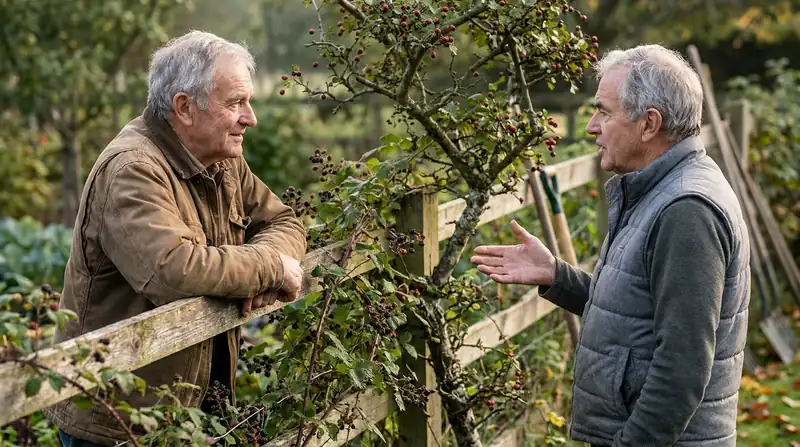
The man on the other side is Merle.
He's seventy-one, he walks the county road every morning, and he gave up alcohol more than twenty years ago.
Merle doesn't make speeches about it.
But he reads labels the way other men read box scores, and he won't keep a bottle of anything with alcohol in it in the house.
This fall he'd been reading about hawthorn.
It's the tree in our own bramble, and he'd learned that people have used its berries for a very long time.
So what was the problem? Every hawthorn extract he'd found at the store was made with alcohol.
He'd turn the little bottle over, see the percentage on the back and put it right back on the shelf.
Then his daughter found something different.
It was a syrup made from hawthorn berries in glycerin and honey, with no alcohol at all, from an herb company in Oregon.
She bought him a bottle and left it on his kitchen counter with a note.
The note said there was no alcohol in this one, and that she had checked twice.
He brought it to the fence the next morning, still in the box.
He hadn't opened it, because he wanted to know what he was opening first.
"You read these things for a living," Merle said over the wire.
"Read this one for me before I open it."
So this is that reading: one bottle of hawthorn berry syrup, taken off a quarter-teaspoon measure, read from the front label all the way to the return policy.
It isn't medical advice, and it isn't a verdict on anybody's heart.
It's a neighbor's reading of a small bottle, written down so you can check my work.
By the end, you'll know what's in the bottle, what the research on the berry does and doesn't say, and what the seller will and won't take back.
You'll also know a few things that cost nothing at all and do more than any bottle.
The Old Hawthorn in the Bramble
What is hawthorn, exactly? It's a thorny shrub or small tree of the rose family, and it grows in temperate places all over the world. [1]
If you've walked a country lane with hedges along it, there's a fair chance you've passed one without looking twice.
The leaves are small and lobed, and the branches carry long, straight thorns.
The small red fruits are called haws, and they ripen in the fall, which is when they're picked.
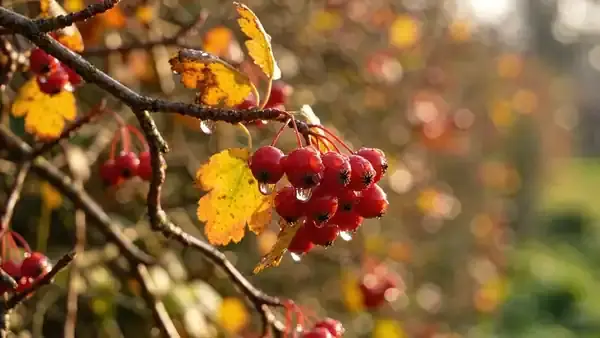
People have eaten those berries for a long time.
A review of the plant's chemistry notes that Native American tribes ate the fruit as food, and that hawthorn has a long history as a food in Europe and in China. [2]
In China, the fruit is known as shanzha.
In the old European hedgerows, it was simply part of the fall, along with the blackberries and the rose hips.
So when somebody tells you hawthorn berry is an old food, they're right.
It went into kitchens long before it went into bottles.
Before it was a supplement, the haw was something people ate.
My grandmother never did anything with ours; she left them to the birds.
But I've always liked that tree, standing its ground in the middle of the canes and going red all over in October.
Why would a man care about a berry on a hedge? Because hawthorn is one of the plants people reach for when they start thinking about the heart and circulation.
And sooner or later, most of us start thinking about the heart and circulation.
What Starts Crossing a Man's Mind After Sixty
I'm not going to describe anything frightening here, because nothing frightening happened to Merle.
What happened is simpler, and I suspect you know it well.
You start noticing the heart and circulation as a subject. Not as a worry, exactly, but as a topic that keeps coming up.
At the diner, at church, on the phone with your brother, somebody always has a story about their yearly checkup.
You notice the hill on the county road a little more than you did at fifty.
You notice that your friends talk about walking and salt and the yearly visit the way they used to talk about cars.
You notice that the conversation at the fence has changed, too.
It used to be the ball game and the price of gas, and now it's what the clinician said at the last visit.
Is that a bad sign? Not in itself.
Mostly it's a sign that you've reached the age when paying attention is simply sensible.
And paying attention makes a man want to do something.
Something small, something daily, something he can do himself between one checkup and the next.
That's the moment when a lot of men start looking at the herb shelf.
And the herb shelf is a confusing place, full of small bottles with small print and big words.
Wanting a small daily habit is reasonable. Choosing one without reading the label is not.
What does the shelf usually offer? Capsules, powders, teas and little bottles of liquid extract.
Each one has its own gesture, its own taste and its own list of things you should know.
Merle had ruled out capsules because he simply doesn't like swallowing them.
He'd tried a hawthorn tea and liked it, but he doesn't always have the patience to let a cup steep.
That left the liquid extracts.
And that's where he kept running into the same line on the back label.
What We Already Do, and Where It Stops
Before anything new comes into the house, it's worth looking at what's already working.
Most men over sixty have a system for the heart and circulation, even if they've never called it one.
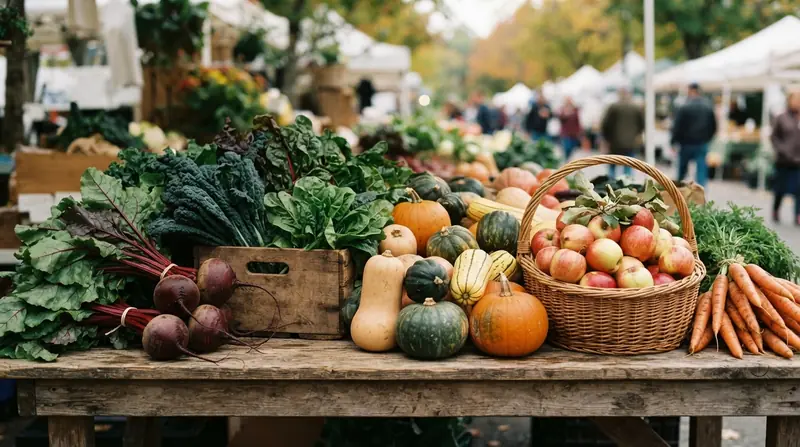
Does the walk count? More than anything in this article.
Federal activity guidelines set a weekly range of 150 to 300 minutes of moderate activity, such as a brisk walk, plus muscle work on two or more days. [3]
Does the plate count? It does.
The current dietary guidelines set a goal of three servings of vegetables and two of fruit a day, eaten whole. [4]
Does the salt shaker count? Less than you'd think.
Over 70% of the sodium Americans eat comes from packaged and prepared foods, so the label on the box matters more than the shaker. [5]
And the yearly visit? That one counts most of all.
Of the eight things the American Heart Association scores, four are daily habits and four are measurements best checked with a clinician. [6]
So the walk, the plate, the label and the visit are already on the list.
Later in this story I'll give them a section of their own, because they belong there.
So where does it stop? It stops where most men want one more small thing.
Something from a plant with a long history, taken on purpose, once or twice a day.
The basics do the heavy lifting. A small daily ritual is simply what many of us want on top.
There's nothing wrong with wanting that.
But it's exactly the moment when you need to know what's in the bottle, what's behind it and what it costs you.
Merle put it more simply.
"I don't want to be sold something," he said. "I want to know what I'm putting in my tea."
Why So Many Herbal Extracts Come in Alcohol
Here's the line Merle kept running into.
Many of the liquid herbal extracts on a store shelf are made with alcohol, and the back of the bottle says how much.
Why alcohol? Because it's a good solvent, and it keeps the bottle from spoiling.
Herb makers have used it that way for a long time, and for most people it works fine.
So why does it matter? For most people, the amount in a serving is tiny.
For scale, a standard drink in the United States holds about 14 grams of pure alcohol, the amount in a 12-ounce beer at 5%. [7]
A single serving of an extract made with alcohol holds a small fraction of that.
But for a man like Merle, the amount isn't the point.
He stopped drinking for his own good reasons, and he doesn't make exceptions by the spoonful.
Plenty of people feel the same way for reasons of their own: faith, family, a promise or just a preference.
Is there another way to make an extract? There is.
Some makers use vegetable glycerin instead of alcohol.
Glycerin is a clear, sweet, syrupy liquid obtained from plant oils.
In an alcohol-free extract it's the base: it sweetens, carries the other ingredients and helps keep the bottle from spoiling.
Honey can do some of the same work.
It's thick and sweet, and people have used it as a sweetener and a base for herbal syrups for thousands of years.
What's the catch with glycerin and honey? Two things, and I'll come back to both.
Honey means a little sugar, and a thick syrup doesn't pour or measure like a thin liquid.
No alcohol, but a little honey. Every base has something to count.
When Merle's daughter handed him this bottle, the first thing he checked was the word "alcohol."
It isn't on the panel, and the listing says "alcohol-free" in plain words.
That settled his first question.
It didn't settle the rest, and that's where I came in.
A Measuring Spoon Instead of a Glass
How do you take a syrup like this? With a spoon.
The label's direction is a quarter teaspoon, two or three times a day.
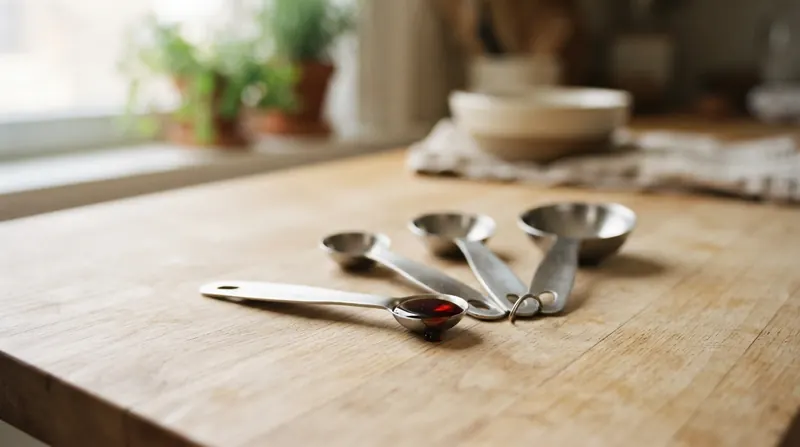
That's one of the smallest measures in a kitchen spoon set.
You'll find it at the back of the drawer, usually still clipped to the others.
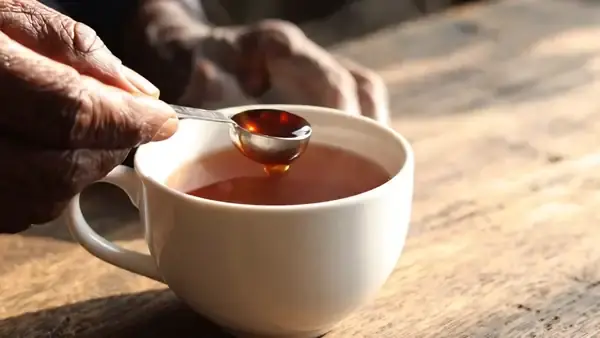
Straight, or in something? Either way.
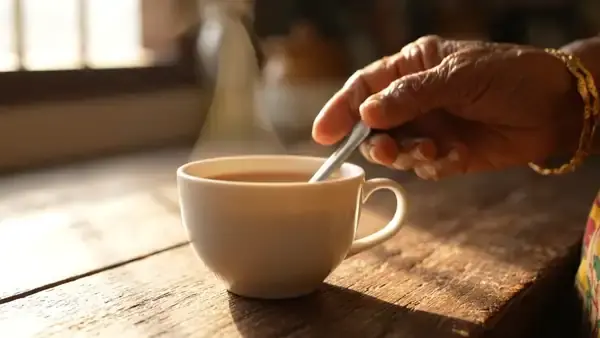
The seller's own answer is that it blends well with warm or cool drinks, so you can stir it into tea or take it straight off the spoon.
I like that gesture more than I expected to.
There's no bulb to squeeze, no water to measure and no capsule to swallow.
Why not a capsule? A capsule keeps its contents out of sight, and some men simply don't like swallowing them.
A spoonful of syrup you can see, smell and taste, and for a man like Merle that's the difference between a habit and a bottle forgotten in a drawer.
What does it taste like? Sweet.
The listing describes a rich, smooth, sweet taste, and two of the buyers' reviews say the same thing in their own words.
Sweetness matters more than people admit.
A daily habit that tastes good is a habit you'll actually keep.
Is there a downside to a spoon? One small one: a syrup is sticky.
You'll want a damp cloth for the rim of the bottle and the threads of the cap, the same as with a honey jar.
One small spoon, two or three times a day. That's the whole gesture.
So far, the bottle had passed Merle's first test.
Now came the part I always do before a bottle comes into anybody's house.
Four Questions Before a Bottle Comes Into the House
I've read a lot of labels for a lot of neighbors.
Over the years it has come down to four plain questions.
First: what exactly is in it? Not the picture on the front, but the panel on the back.
The panel is the part of the bottle that has to list what's inside.
Second: what does each ingredient have behind it? A study in people, a study in rats, a chemical analysis or nothing at all.
And what did that study actually measure?
Third: who makes it, and can I reach them? A real street address and a phone number a person answers.
If something goes wrong, you want a name, not a web form.
Fourth: what will they take back? The return terms are the only part of a purchase that protects you when the rest doesn't work out.
Most people read them after the fact, and that's backward.
Four questions: the panel, the research, the company and the return terms.
None of those questions requires a degree.
They require a pair of reading glasses and a little patience, which Merle and I both have in good supply.
Why this order? Because it's the order in which things can go wrong.
A good company can make a label that doesn't add up, and a good label can sit on thin research.
Merle nodded at that.
"Like a good cook with a bad recipe card," he said, which is about right.
So let's take them one at a time, starting with the company, because that's where the bottle comes from.
Then the panel, then the research, and last of all the return terms.
An Herb Company in Creswell, Oregon
The bottle is called Hawthorn Botanical Syrup, and the listing adds two words in parentheses: Solid Extract.
It's made by a company called Wise Woman Herbals.
Where is Creswell? It's a small town in Oregon's Willamette Valley, a short drive south of Eugene.
The company lists a street address there, 185 N. Mill St., and a post office box in the same town.

Can you call them? Yes, and that's the second thing I look for.
They list a toll-free number, 800.532.5219, and a local line, 541.895.5152, open weekdays from nine to five Pacific time.
There's an email address too, and the company says replies come within one or two business days.
A company that prints a street address and two phone numbers is a company that expects to be found.
How long have they been at it? One of the company's own pictures says "Trusted since 1989."
That's their phrase, not mine, but it's a long time to keep an herb company going.
The listing also says the herb is certified organic by Oregon Tilth.
It adds "Non-GMO," "Additive-Free" and "Quality Tested," which are the maker's own words.
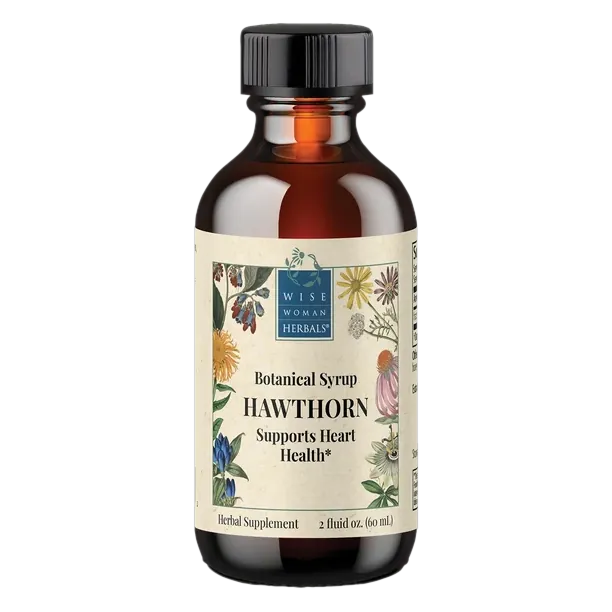
What does the front of the bottle say? Three lines, on a cream label with old botanical engravings around the edges.
First "Botanical Syrup," then "HAWTHORN" in large letters, then the claim the label makes for it: "Supports Heart Health"*
That last line is a structure-and-function statement, the kind of general claim a supplement label is allowed to make.
It carries the standard asterisk and the note that the Food and Drug Administration hasn't evaluated it.
Is that the only claim? On the bottle, yes.
The listing's text says more, and I'm leaving those extra words where they are, because this page sticks to what the label itself says.
The front says three things. We'll take the label at its word and no further.
The syrup comes in three sizes: two ounces, four ounces and eight ounces.
The two-ounce bottle is the one Merle's daughter bought, and it's the one I'd start with, for reasons you'll see when we get to the return terms.
What "Solid Extract" Means on a Label
Those two words in parentheses made Merle squint.
He tipped the bottle and said it didn't look solid to him, only slow.
So what is a solid extract? In the herb trade, it's the name for an extract made thick.
Thick enough that you spoon it rather than pour it into a glass.
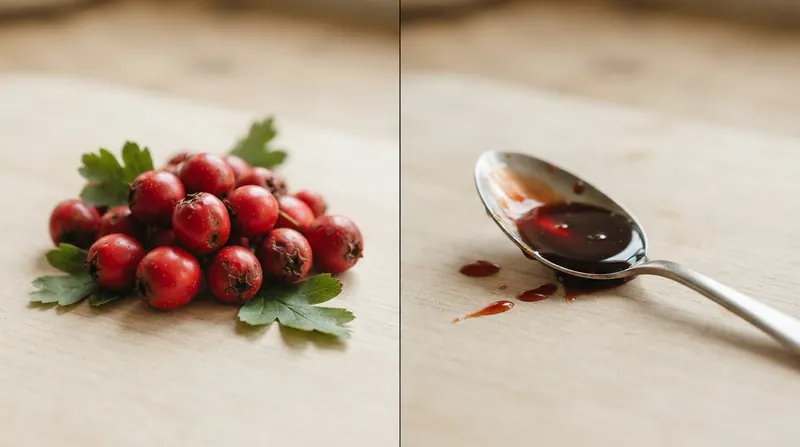
The label doesn't describe how this one is made, beyond two facts.
The plant part is the berry, and the extract ratio is 4:1.
What does 4:1 mean? By the usual convention, four parts of plant went in for every one part of finished extract.
It's a way of saying the extract is more concentrated than the berry it came from.
Four parts of what, though? That's the question the label doesn't answer.
It doesn't say whether the ratio counts fresh berries or dried ones, or whether it was measured by weight or by volume.
It also doesn't name the species.
The panel says "Crataegus sp.," which is a botanist's way of saying "a hawthorn," without saying which of the many hawthorns it is.
Does the species matter? It can.
The review of hawthorn chemistry I mentioned earlier notes that the chemistry varies from one species to another. [2]
So a 4:1 hawthorn berry extract from one maker isn't automatically the same as a 4:1 hawthorn berry extract from another.
That's worth knowing before you set two bottles side by side and compare them by the ratio alone.
The ratio tells you it's concentrated. It doesn't tell you how much berry is in your spoon.
Could you call and ask? You could, and that's the beauty of a company with a phone number.
If the species or the weight of berry matters to you, 541.895.5152 is the line to try.
Merle wrote the number on the box in pencil.
That's the kind of reader he is, and I suspect it's the kind of reader you are.
The Panel, Line by Line
Here's the bottle itself, the way the seller photographs it.
Two ounces of amber glass, a black screw cap and a cream label with the three lines I read you earlier.
Now turn it around.
The back panel is short, and that's not a criticism; it's a one-herb product.
What's the serving? "1/4 teaspoon (2 mL)," with 30 servings to the bottle.
There's one active line: hawthorn berry extract, 2 mL, with no Daily Value, because there isn't one for hawthorn.
What else is in it? Two things, listed as other ingredients: vegetable glycerin and honey.
That's the base the berry extract sits in, and there's nothing else on the panel.
Is the 2 mL all berry? Not quite, and here's how I read it.
The panel lists the hawthorn berry extract at 2 mL and then names glycerin and honey as the other ingredients.
The plain reading is that the whole 2 mL is the finished extract, base included.
The label doesn't split it into so much berry, so much glycerin and so much honey.
How much honey is there, then? The label doesn't say.
It doesn't print a sugar line either, and I'll come back to that in a minute.
Here's what the panel does give you, in plain terms.
One herb, one plant part, one ratio, two base ingredients and no alcohol.
- Hawthorn, the berry, extracted at 4:1.
- A serving of 2 mL, or a quarter teaspoon, by the label.
- Vegetable glycerin and honey as the base.
- No alcohol, no other herbs and no added flavors on the panel.
That's a short, readable panel.
I'll give the maker credit for that before I get to the part that sent me looking for a calculator.
One herb, one part, one ratio. Short panels are easier to read.
A Quarter Teaspoon Is Not Two Milliliters
Here's the one thing on the label that doesn't add up, and I'd rather tell you than have you find it yourself.
The serving is printed as "1/4 teaspoon (2 mL)."
What's wrong with that? A US teaspoon holds just under 5 milliliters.
So a quarter teaspoon is about 1.2 milliliters, not 2.
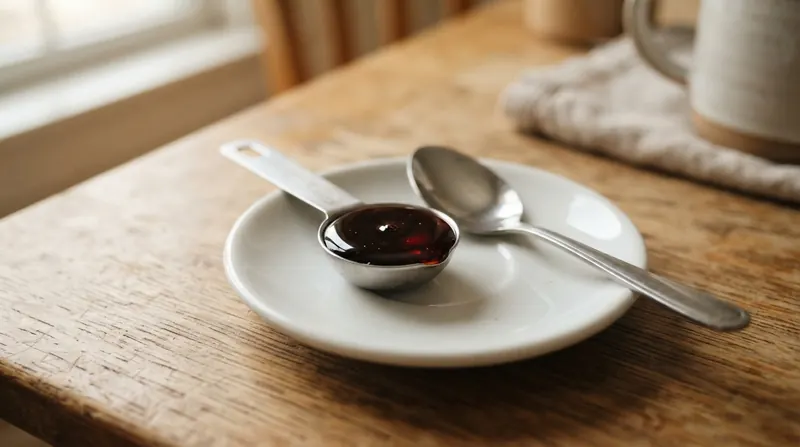
Two milliliters is closer to four tenths of a teaspoon.
That's not a big difference in a spoon, but it's a big difference over a bottle.
How big a difference? The bottle holds 60 milliliters.
At 2 mL a serving, that's 30 servings, which is what the label says.
At a true quarter teaspoon, about 1.2 mL, it's closer to 48 or 49 servings.
Same bottle, same syrup, more than half again as many spoonfuls.
How long does a bottle last? It depends on which number you follow and how many times a day you take it.
The label says two or three times daily, so here are the four ways it can go.
- At 2 mL, twice a day: about 15 days.
- At 2 mL, three times a day: about 10 days.
- At a quarter teaspoon, twice a day: about 24 days.
- At a quarter teaspoon, three times a day: about 16 days.
So a two-ounce bottle lasts somewhere between ten days and a little over three weeks.
That's worth knowing before you decide whether the price makes sense to you.
Which number is right? I can't tell you how the mismatch happened, only that the two numbers don't agree.
The spoon is the measure you can actually find in the drawer, and the milliliters are the ones the math of the bottle is built on.
If it matters to you, and it should, call the company and ask which one they mean.
A label should agree with itself, and a small company with a phone line is the easiest kind to ask.
One label, two numbers. A phone call settles it.
I'm not pointing this out to make the maker look bad.
The rest of the panel is plain and readable, and this is one line that slipped.
But it matters for two things: how much you take, and how long the bottle lasts.
And it's exactly the kind of thing you only notice if you read the panel with a spoon in your hand.
The Honey in the Base, Counted as Sugar
Merle's first question was about alcohol.
His wife's first question, when she saw the bottle on the counter, was about sugar.
Is there sugar in it? There's honey, so yes, a little.
The label doesn't say how much honey is in the base, so here's the most I can tell you from the numbers.
Honey is mostly sugar.
By the federal food database, 100 grams of honey holds about 82 grams of carbohydrate, most of it fructose and glucose, and a tablespoon weighs 21 grams. [8]
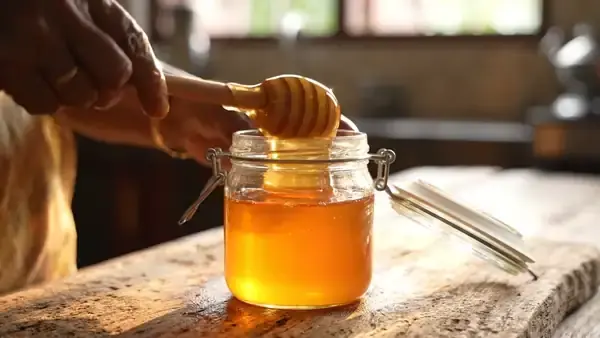
So how much sugar is in a quarter teaspoon? A quarter teaspoon is a twelfth of a tablespoon.
If the whole quarter teaspoon were pure honey, it would weigh about 1.75 grams and carry about 1.4 grams of carbohydrate, nearly all of it sugars.
But it isn't pure honey.
It's honey, glycerin and berry extract together, so the real figure is smaller than that.
What about three servings a day? Even at the most generous count, pure honey, three quarter teaspoons would come to a little over 4 grams.
That's about what's in a level teaspoon of table sugar, spread across a whole day.
If you follow the 2 mL figure instead of the spoon, the numbers go up by more than half.
Still small, but still sugar.
Should that matter to you? If you watch your sugar closely, count it, the way you'd count a spoonful of honey in your tea.
If you don't, it's a very small line on the day.
What about the glycerin? It's sweet too, but it isn't honey, and it isn't counted as sugar the same way.
Large amounts of glycerin can loosen the stomach, and a quarter teaspoon of syrup is nowhere near a large amount.
A little honey, counted honestly, is still a little.
There's one more line about honey, and it isn't about sugar.
Honey is not for babies under one year old.
That matters here because a bottle of sweet syrup looks like something you could give a small child.
The label itself says to keep the bottle out of the reach of children, and I'd take that literally.
And if you react to bee products, this bottle isn't for you.
The honey is part of the base, and there's no way to take it out.
Berry, Leaf and Flower Are Different Parts of the Plant
Here's something that surprised Merle, and it surprised me too the first time I read it.
Most of what Europe's regulators have written about hawthorn is about the leaf and the flower, not the berry.
Why does that matter? Because they're not the same thing in a bottle.
Europe's herbal monograph on hawthorn covers the dried leaf and flower, for tea or for a liquid extract. [9]
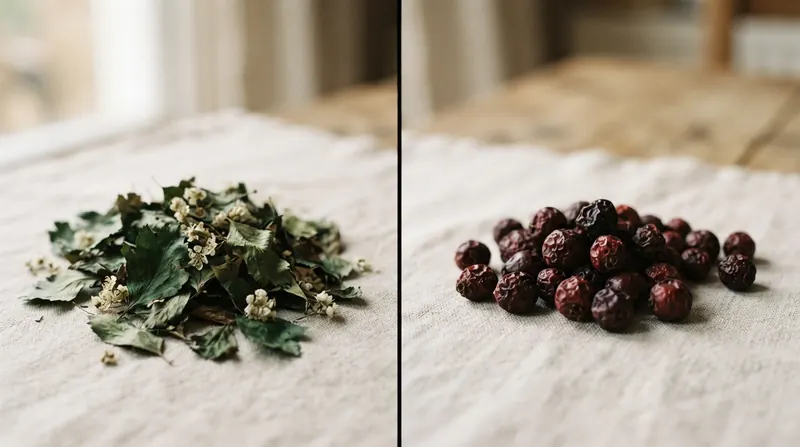
What's different inside? One chemical analysis of a North American hawthorn gives a good picture.
The leaves held far more of a compound called hyperoside than the fruit did, about 2 to 11 milligrams per gram against 0.5 to 1. [10]
The leaves also held a family of compounds related to vitexin, which showed up only in traces in the fruit. [10]
Both the leaves and the fruit held epicatechin and two procyanidins, at milligrams per gram. [10]
Does ripeness change things? In a European hawthorn, it did.
The unripe fruit held the most phenolic compounds, the over-ripe fruit held the most sugars, and the flowers held the most vitamin C. [11]
So which part is in this bottle? The berry, by the label.
That means the chemistry in your spoon is the fruit's chemistry, not the leaf-and-flower chemistry most of Europe's paperwork describes.
Same tree, different parts, different chemistry. This label names the berry.
What does Europe say the leaf and flower contain? Flavonoids such as vitexin and hyperoside, compounds called procyanidins, and a few organic acids. [12]
Its pharmacopoeia requires the dried flowering branches to contain at least 1.5% total flavonoids. [12]
And the amounts Europe describes? For the leaf and flower, a tea of 1 to 2 grams of the dried herb in a cup of boiling water, up to four times a day. [9]
None of that is a berry measurement, and I only give it to you so you can see how differently the two parts are handled.
Before you believe a hawthorn article, find out which part of the tree it means.
What the Research Says, and Where It Goes Quiet
Now the honest part, and I'll keep it plain.
The research on hawthorn is thin, and the research on the berry alone is thinner.
What does the federal government say? The National Institutes of Health's center for complementary health says there's little or no quality evidence on hawthorn for most uses. [1]
It adds that no studies have tested hawthorn supplements beyond 16 weeks. [1]
Has anyone tested a hawthorn berry syrup like this one? Not that I could find.
We found no trial of the berry alone in healthy adults, and no trial of this bottle.
What about how the body takes it in? Here the paperwork is candid.
Europe's assessment report says only a few studies have looked at how the body handles hawthorn's compounds, so that remains largely unknown. [13]
One study it cites found an oral bioavailability of only 3.57% for one flavonoid typical of the leaf. [13]
In rats, two related compounds peaked in the blood within 45 minutes and weren't found in brain tissue at all. [13]
Is that true in people? Nobody knows yet, and that's the point.
In cell and rat experiments, the main flavonoids of the hawthorn leaf crossed the gut lining poorly. [14]
What about blood vessels? A 2026 laboratory study tested twenty-one compounds found in hawthorn or formed from it in the body, on blood vessels taken from pigs and rats.
Two of them widened the vessels, but only at concentrations far above what's typically measured in human blood. [15]
That's a vessel in a dish, not a person, and the authors' own numbers show how big the gap is.
It's the kind of study that tells researchers where to look next, not what's happening in your spoon.
Are there side effects? The federal summary lists dizziness, nausea, vomiting, diarrhea and muscle aches as possible ones. [1]
It says short-term use of some hawthorn supplements may pose little risk, and that little is known about use during pregnancy or breastfeeding. [1]
Thin evidence, said plainly, is more useful than a big promise.
I know that's not the section a seller would write.
But Merle asked me to read it, and that's what's there.
What It's Fair to Say the Syrup Supports
So after all that, what can a man honestly say about this bottle?
Here's how I'd put it across the fence, without stretching anything.
What does the label claim? "Supports Heart Health," with an asterisk.
That's a general statement about normal function, and it's the only claim printed on the bottle.
What does the history say? That hawthorn berries have been eaten as food for a very long time, in Europe, in China and by Native American tribes. [2]
That's a real history, and it's one reason the plant keeps getting studied.
What does the chemistry say? That the fruit carries flavonoids and procyanidins, in amounts that change with the species, the plant part and how ripe the fruit is. [10] [11]
That's a description of the plant, not a result in a person.
What does the research in people say? Very little that applies to a berry syrup, and I won't pretend otherwise.
If you choose this bottle, choose it as a small daily ritual from a plant with a long history, not as a result you've been promised.
- A sweet, alcohol-free way to take hawthorn berry, by the spoon.
- One herb and one plant part, both named on the label.
- A company you can call, with a street address in Oregon.
- A long history as food, and a chemistry that has been measured.
- No trial of the berry alone in healthy adults, and none of this bottle.
That last line belongs on the list as much as the others do.
A list without it would be a sales pitch, and you'd be right not to trust it.
A small ritual, honestly described, is worth more than a big promise.
Tejocote Root, and Why Naming the Berry Matters
There's one more thing in the federal summary that every hawthorn buyer should know.
It isn't about this bottle, but it's the reason I like that this bottle names its plant part.
What happened? The Food and Drug Administration has warned about several hawthorn root products, labeled "tejocote root," that actually contained yellow oleander, a toxic plant. [1]
Tejocote is a Mexican hawthorn, and those were root products, not berry, leaf or flower.
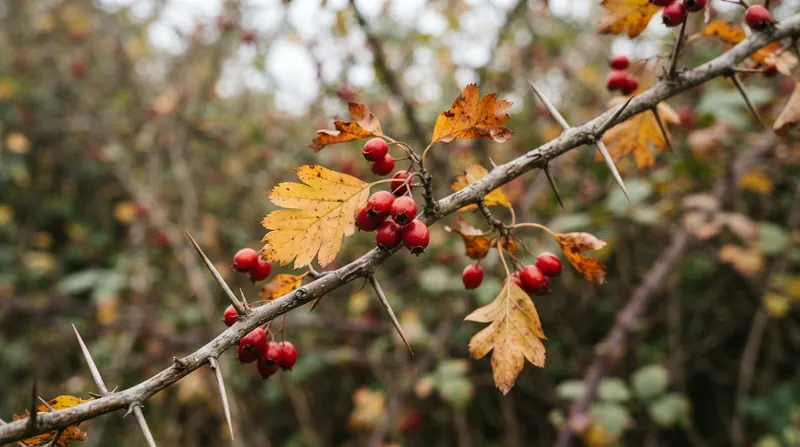
What's the lesson? Buy hawthorn from a maker that tells you which part of the plant is in the bottle.
This label does: it says berry, and it names the genus.
It doesn't name the species, as I said earlier.
But the plant part is printed plainly, and the plant part is what the tejocote case was really about.
Should you pick the berries off your own hedge instead? I wouldn't, and neither would Merle.
There are many kinds of hawthorn, and a hedge doesn't come with a label.

The berries in our bramble go to the birds every year, and that's where they'll stay.
If you want hawthorn, a named plant part from a maker you can call is the sensible route.
A Normal Day With the Bottle on the Counter
So what would it look like to use it?
Here's how I'd fit it into an ordinary day at our end of the road, if I were the one trying it.
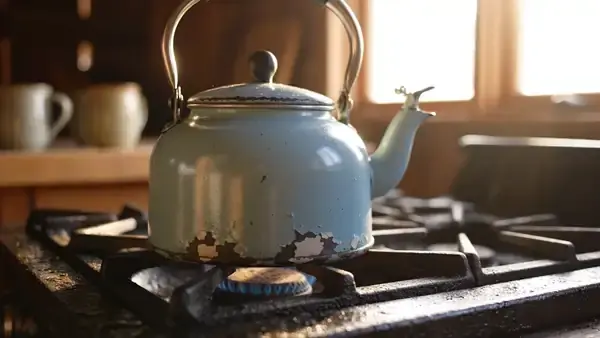
Morning. The kettle goes on, the tea goes in the cup, and a quarter teaspoon of syrup goes in after it.
Stir, and drink it while you read the paper.
That's the easiest way I know to make a habit stick.
You attach the new thing to something you already do without thinking.
Midday. After lunch, a second quarter teaspoon, straight off the spoon this time.
It's sweet, so it doubles as the end of the meal.
Afternoon. A walk, which matters more than anything in the bottle.
Down the county road, along the hedges and back past the bramble.
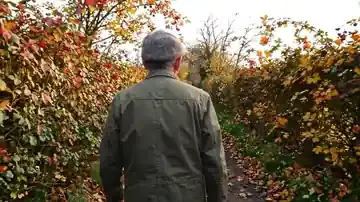
Evening, if you take a third? The label allows two or three servings, so a third is up to you.
I'd take it in an evening cup of tea, and I'd skip it if two feels like plenty.
How would you know if it's doing anything? Honestly, you may not feel anything, and that's worth saying up front.
This is a small daily ritual, not something you're meant to feel by the afternoon.
What you can notice is the habit itself.
Did you take it, did you walk, did you drink your water, did you eat something green?
The syrup rides along with the day. The day does most of the work.
What if you miss a day? Then you miss a day, and you pick it up the next morning.
Don't double up; the label says a quarter teaspoon, two or three times a day.
Who It Suits, and Who Should Pass
Not every bottle belongs in every kitchen.
Here's how I'd sort it, as plainly as I can.
It suits a man who wants hawthorn without alcohol. That's the whole reason this bottle exists, and it does that job.
It suits someone who'd rather take a sweet spoonful than swallow a capsule.
It suits someone who reads labels and likes a short one.
And it suits someone who understands the evidence is thin and wants a small ritual anyway.
It doesn't suit babies under one year old, because of the honey. That's a firm line, not a preference.
It doesn't suit children either: the label says to keep it out of their reach, and Europe's monograph doesn't recommend hawthorn leaf and flower for children. [9]
It doesn't suit anyone who is pregnant or breastfeeding, unless a clinician says otherwise.
Little is known about hawthorn in those months, by the federal summary, and Europe's monograph doesn't recommend the leaf and flower then. [1] [9]
It doesn't suit anyone who reacts to bee products.
Honey is in the base, and there's no way to take it out.
It doesn't suit a man who takes anything daily and hasn't asked his pharmacist. Hawthorn is sold for the heart and circulation, and that alone is reason enough to ask first.
The next section is about exactly that conversation.
And it doesn't suit anyone expecting a result.
If what you want is a change somebody can measure, the place for that conversation is your own clinician's office, not a kitchen drawer.
A sweet spoonful suits a small, honest purpose. It can't carry a bigger one.
Two Questions for the Pharmacy Counter
This is the cheapest five minutes in this whole story.
Take the bottle, and everything else you take daily, to your pharmacist.
Why the pharmacist? Because the label can't see what else is in your cabinet.
Your pharmacist can, and it's their job to notice when two things don't belong together.
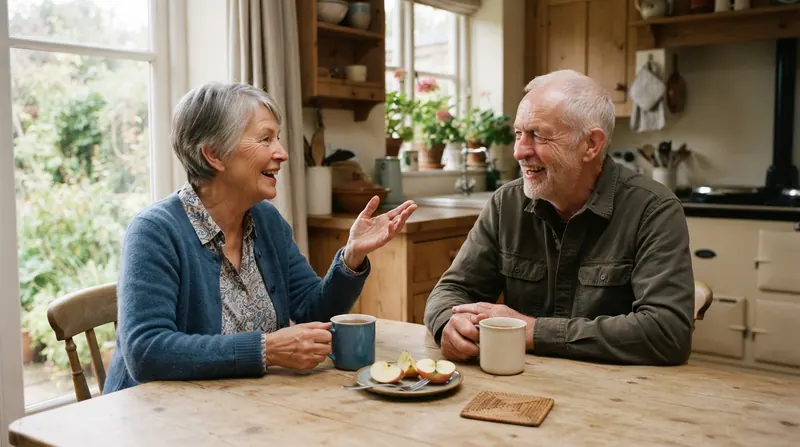
Put it all in one bag, even the things you buy off the shelf, and set the bag on the counter.
Then ask two short questions.
- Does anything I take daily argue with hawthorn?
- Is there any reason honey or glycerin is a poor fit for me?
Why hawthorn in particular? Because it's a plant sold for the heart and circulation.
The ingredient card for hawthorn berry in our guide says the same thing: if you take anything daily, show the label to your pharmacist before adding it.
What if the pharmacist says no? Then the bottle stays in the box, and if the seal is still intact, you still have the return terms to work with.
That's a good outcome too.
Five minutes at the counter. Nothing else on this page costs less.
The Fair Objections, Answered Across the Fence
Merle had objections, and so did his wife.
They're good ones, and here's my honest answer to each.
Objection one: "It isn't cheap for two ounces." The seller sets the price, and it changes, so check it on the listing before you order.
What I can do is tell you how to think about it.

Remember the arithmetic from earlier: a two-ounce bottle lasts somewhere between ten days and three weeks, depending on how you measure and how often.
Divide the price by the number of days you'll actually use it, and decide whether that's worth it to you.
If it is, the four-ounce and eight-ounce bottles cost more each but less per ounce.
I'd still start with the smallest, and you'll see why in the next section.
Objection two: "It's basically candy." It's sweet, yes.
But even three servings a day add up to about a teaspoon of sugar at the most generous count, and probably less.
Objection three: "The evidence is thin." You're right, and I've said so in plain words.
There's no trial of the berry alone in healthy adults that I could find, and none of this bottle.
If thin evidence is a deal-breaker for you, that's a sound reason to pass.
If you want the ritual anyway, at least you're choosing it with your eyes open.
And a fourth, from Merle's wife: "Why not just make tea from the tree out back?" I covered that already.
There are many kinds of hawthorn, the bramble doesn't come with a label, and the berries belong to the birds.
Every objection has an honest answer. Some of those answers are "you're right."
The Return Terms, Read Out Loud
Here's the part I promised Merle I'd read twice.
This bottle does not come with a satisfaction promise.
The top of the seller's website says "Easy returns."
The written policy is more specific, and it's the written policy that counts.

What does the policy say? You call first, at 541-895-5152, and ask for a return authorization.
The company says it won't accept products without one.
How long do you have? You have to let them know within 7 days of receiving the goods.
The item then has to be back with them within 30 days of purchase.
Can you open it? No.
The item has to be unopened, with the safety seal intact, and as new.
Is there a fee? If the return isn't due to the company's error, there's a 15% restocking and bookkeeping fee.
So even an unopened bottle you changed your mind about comes back at 85 cents on the dollar.
So what does that mean in plain words? If you open the bottle and don't like the taste, you keep the bottle.
If you open it and it simply doesn't suit you, you keep the bottle.
Once the seal is broken, the bottle is yours. Plan on that before you order.
That's why I'd start with the two-ounce size.
It's the smallest bet, and if you like it, the bigger bottles will still be there.
Is that unfair? Not necessarily, since a seller of something you swallow has its reasons for not taking opened bottles back.
But "Easy returns" is a softer phrase than the policy underneath it, and you deserve to know the difference before you order.
What about shipping? Orders leave in five to seven business days, and standard shipping is at no charge on orders over $50 within the United States.
Below that, standard shipping is $10, and orders to Canada, Alaska, Hawaii and Puerto Rico can take up to eight weeks.
Read the return terms before the order, not after the seal.
What the Buyers Wrote
I always read the reviews last, after the label, the research and the terms.
Reviews are useful for one thing above all: what a product is like to live with.

How many reviews are there? When I read the listing, there were seven, and all seven gave five stars.
All seven were also marked by the seller's review system as confirmed purchases.
Four of them are unsigned and talk about personal health matters that this page doesn't print, so I've left them on the seller's page.
The other three are below, word for word.
They're short, they're opinions rather than evidence, and the small pictures beside them are illustrations, not the reviewers.
One name appears in capital letters because that's how it was posted.

I take the Hawthorne Solid extract for heart health. It tastes delicious.

Rarely do herbal supplements taste so good!

Wonderful!
What do I take from them? Two of the three are about taste, and that fits everything else on this page.
The appeal of this bottle is a sweet spoonful without alcohol, and that's what the buyers noticed.
None of them tells you what the syrup will do for you, and I wouldn't trust a review that claimed to.
But seven confirmed buyers and no rating below five stars tells you the people who bought it liked what they got.
Things Along the Bramble That Cost Nothing
Before I hand the bottle back across the fence, there's a list I always add.
It's the things that do more for the heart and circulation than any bottle, and none of them can be sold to you.
Walk, and count minutes before steps. The federal guidelines set 150 to 300 minutes a week of moderate activity, spread through the week. [3]
Any bout counts toward that, even a few flights of stairs, and 10,000 steps a day is popular advice rather than a guideline. [16]
Walk fast enough to talk but not sing. That's the CDC's talk test for moderate activity, and walking briskly at 2.5 miles an hour or faster counts. [17]
In healthy adults aged 61 to 85, a pace of about 100 steps a minute marked the start of moderate intensity. [18]
Add strength and balance. Muscle work on two or more days a week, and for older adults, balance training too, at an effort set by your own fitness. [3] [19]
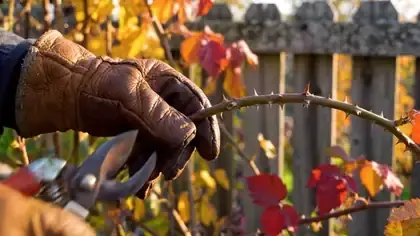
Cutting back a bramble won't replace a real strength routine, but every bout of activity counts toward the week. [16]
Fill the plate with vegetables. Three servings of vegetables and two of fruit a day, eaten whole, on a 2,000-calorie pattern. [4]
About 80% of the nitrate in the diet comes from vegetables, and the body turns part of it into nitrite with the help of bacteria in the mouth. [20]
Read the sodium line. Americans eat about 3,400 mg of sodium a day against a limit of less than 2,300 mg, about a teaspoon of salt. [5]
That limit applies to everyone 14 and older, and the guidelines say to avoid highly processed foods that are salty or sweet. [21]
Drink water, and less of the rest. The guidelines say to choose water and unsweetened drinks, to avoid sugar-sweetened ones and to drink less alcohol. [22]
Coffee and tea count toward your daily water, too. [23]
Sleep seven hours or more. Sleep specialists recommend that adults sleep 7 or more hours a night on a regular basis. [24]
That's a habit you keep, not something any bottle hands you.
If you smoke, stopping helps at any age. The CDC says so, no matter how long or how much a person has smoked. [25]
Within a few days of quitting, the carbon monoxide in the blood drops to the level of someone who doesn't smoke. [25]
Keep the yearly visit. Half of the things the American Heart Association scores are measurements best checked with a clinician. [6]
No spoon, no bottle and no article can stand in for that.
The cheapest things on this list have the most behind them.
None of these replaces a spoonful of syrup, and the syrup doesn't replace any of them.
But if you only had room for one, I'd take the walk every time.
The Whole Bottle on One Recipe Card
If I had to fit this whole reading on a recipe card and tuck it in Merle's mailbox, here's what I'd write.
It's short, because the bottle is short.
- Hawthorn berry extract, 4:1, in vegetable glycerin and honey, with no alcohol.
- A quarter teaspoon, two or three times a day, straight or in tea.
- The label prints the serving as 2 mL; a quarter teaspoon is about 1.2 mL, so a bottle lasts 10 days to a little over 3 weeks.
- A little honey: count it if you watch your sugar, and never give it to a baby under one.
- A long history as food and a measured chemistry, but no trial of this syrup that I could find. [2] [10]
- Pharmacist first if you take anything daily.
- Returns only unopened, reported within 7 days of receipt, with a 15% fee.
- Wise Woman Herbals, 185 N. Mill St., Creswell, Oregon, 800.532.5219.
Two ounces of hawthorn berry syrup, taken by the quarter teaspoon
A thick, alcohol-free hawthorn berry syrup in vegetable glycerin and honey from a small Oregon herb company, taken a quarter teaspoon at a time, straight or stirred into tea.
CHECK AVAILABILITYSold by Wise Woman Herbals, Creswell, Oregon · hawthorn berry extract 4:1 in vegetable glycerin and honey, no alcohol · returns accepted only unopened, reported within 7 days of receipt, with a 15% restocking fee
Questions from over the fence
What kind of product is this?
An herbal supplement in the form of a syrup. It isn't meant for any health problem.
Does it contain alcohol?
No. The base is vegetable glycerin and honey, and the listing calls it alcohol-free.
How much do I take?
The label says a quarter teaspoon, two or three times a day. It also prints that serving as 2 mL, which is more than a quarter teaspoon holds.
Which part of the hawthorn is in it?
The berry, extracted at a ratio of 4:1. The label doesn't name the species.
How much sugar is in a serving?
The label doesn't say. Even if a quarter teaspoon were pure honey, it would carry about 1.4 grams of carbohydrate. [8]
Can children take it?
Not babies under one year old, because of the honey. The label says to keep it out of children's reach.
How long does a bottle last?
About 10 to 24 days, depending on the serving you measure and how often you take it.
Can I return an opened bottle?
No. Returns must be unopened, reported within 7 days of receipt, and carry a 15% fee unless the error was the company's.
Should I talk to anyone first?
Your pharmacist, if you take anything daily. Bring the bottle with you.
Back Along the Fence
I carried the bottle back to the fence on a Sunday afternoon, with the birds working over the hawthorn.
Merle was already there, leaning on the top rail.
I told him what I've told you.
No alcohol, a sweet spoonful, a berry with a long history, a short label with one mismatched number, thin research and a return policy that stops at the seal.
Did he buy it? His daughter already had, so the real question was whether to open it.
He'd already been to the pharmacist, and he said he'd open it with his tea the next morning.
And me? I'll keep walking the county road with him, whatever he decides.
That part of the routine has the longest record of anything we talked about.
If you decide to try it, you now know what's in the spoon, what's behind it and what the seller will take back.
If you decide not to, the walk, the plate and the yearly visit are still yours, and they don't cost a thing.
Read a syrup's label with a spoon in your hand. It's the only way the numbers make sense.
Either way, I hope your own back fence has somebody on the other side of it.
And I hope the birds leave you a few berries this fall.
Sold and shipped by Wise Woman Herbals, Creswell, Oregon. The seller sets the price, and opened bottles are not returnable.
The label's one hawthorn line, its two base ingredients and what the research says about each are written out in the ingredient and advertising guide linked at the foot of this page.
The guide also explains the quarter-teaspoon arithmetic and the two questions worth asking your pharmacist.